
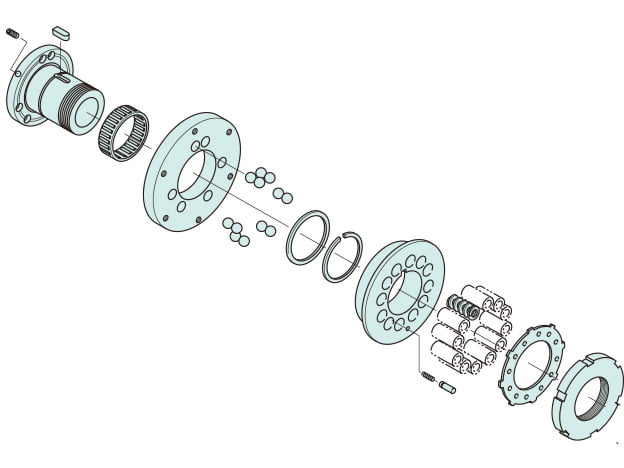
The SUNTES TX torque-releaser family disconnects torque transmission when the drive load exceeds its selected setting. The B, D, E and R configurations share the same basic clutch mechanism. The D-type assembly is used here to explain how the normal transmitting state, overload release and reset sequence differ.
Normal torque transmission
Steel balls retained by the flange are pressed into pockets in the hub boss by spring force. Torque passes from the hub boss through the steel balls to the flange. The hub, flange, balls, springs and adjust ring therefore work together to establish the transmitting and release behaviour.
Overload release and detection
An overload pushes the steel balls out along the sloping surfaces of the hub-boss pockets, interrupting torque transmission. At the same time, the action ring moves axially toward the adjust ring. A limit switch or proximity switch can detect this movement. The mechanical travel provides the detection opportunity; the selected sensor and machine control must be arranged for the actual installation.
Automatic return to the indexed position
First remove the cause of overload. Rotating either the input or output then brings the balls to the prescribed pocket position. There is one reset position per revolution. At that position, spring force automatically returns the balls to the transmitting state. Automatic reset describes this mechanical re-engagement; it does not replace investigation of the original overload or the machine restart procedure.
Configuration and control review
Select the physical configuration to match the mounting interface and driven equipment, then use its own specification tables for the release-torque range, spring arrangement, speed and shaft dimensions. The operating diagrams explain the mechanism rather than assigning a universal rating to every size. For ordering or service discussions, identify the full model, setting, shaft arrangement, overload detector and required restart sequence. Use the component-reference drawing to identify parts accurately and confirm the current operating instructions for the chosen assembly.


Confirm the latest dimensional drawing and specifications for the selected configuration before manufacture or installation.